Author: Katie Kossow
Graphics: Alara Ecemis & Ploen Manopinives
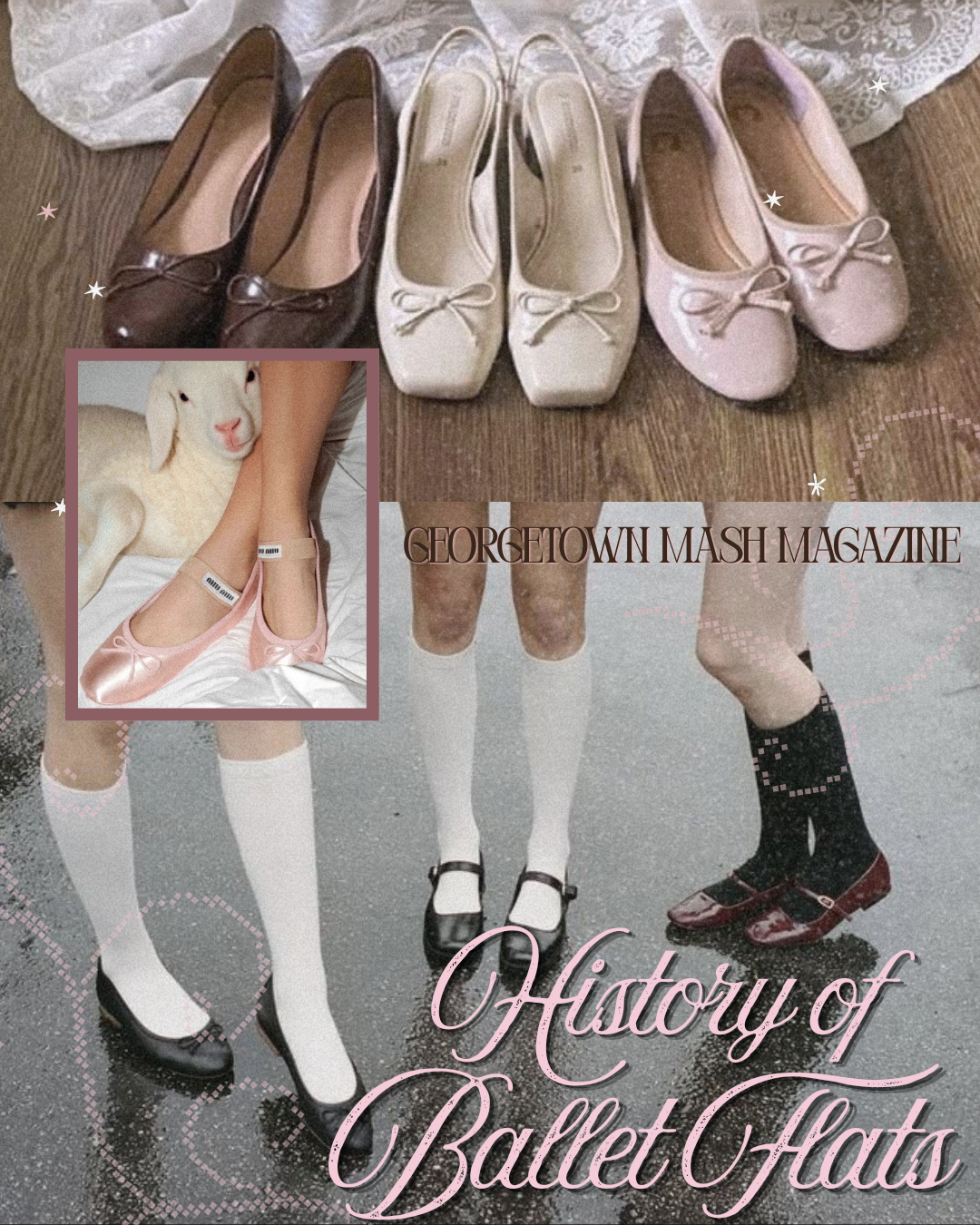
“Flat Out Iconic” - Katie Kossow
It’s the footwear favorite we all know and love: the perfect pair, most versatile veteran, and the flawless finishing touch to any outfit, no matter the occasion. I’m talking, of course, about the ballet flat. We slip them on without a thought, strut out the door, and trust them to complement whatever we’re wearing. But who knew this closet classic had such a historically rich saga?
It all began in 1680 at the Royal Academy of Dance in France, when the original ballet shoe, which featured a heel, made its debut. The shoe was modeled after formal court fashion, and the heel’s purpose was to elongate the dancer’s silhouette. However, because fashion trumped functionality, the heeled design prevented dancers from performing complex choreography, restricting their movements to awkward, shuffling steps.
It was Marie Camargo, renowned ballerina, who became the first woman to premiere a heel-less slipper at the Paris Opera Ballet in 1720. Though she is also known for being the first woman to execute the entrechat quatre, her bravest move of all was defying the fashion norms of her time in favor of freedom of movement. The ballet slipper’s comfortable design enabled dancers to be more explosive and athletic with their footwork, something that contradicted the passivity initially expected of female dancers. As such, the shift from heeled shoes to flat slippers carries a rebellious, feminist essence by rejecting the notion of discomfort for the viewing sake of others, and subverting the male gaze (a film theory developed by Laura Mulvey in which women are positioned as an object of the male’s desire). The ballet slipper allows audiences to revere the dancers’ beautiful technique rather than their choice of footwear, and it’s no surprise it became the preferred shoe of dancers for centuries to come. In fact, in 1910, Anna Pavlova bought a pair of slippers for each member of her company because she loved them so much.
But how did the ballet flat make its transition from the stage to the streets? Typically, when new pieces make their debut, it begins with a grand showcase on a runway. However, the ballet flat became a commercial category through collaboration rather than a catwalk unveiling. In 1941, Claire McCardell, inspired by the shoe’s sleek silhouette, commissioned Salvatore Capezio to create a line of ballet flats that could be worn in daily life. Capezio added a hard sole to better suit the needs of the streets, and voilá! The modern ballet flat was officially in business. McCardell is additionally credited with the creation of more functional, liberating sportswear for women, and her ballet flat arrived at a time when women were stepping into the workforce while men fought in World War II. In this way, the shoe’s transition to everyday wear mirrored women’s growing autonomy of the era.
Just six years later, the ballet flat rose to fame when Italian fashion designer, Rose Repetto, hand-made a pair for her son Roland—a celebrated dancer and choreographer. It was thereafter that the shoe developed a devoted following within the Paris Opera House. Its popularity only accelerated when Brigitte Bardot asked Repetto to make an “elegant city version” for her film, Et Dieu Crea La Femme (And God Created Woman) in 1956. This role transformed Bardot into one of the most influential fashion icons of the 50s and 60s. Joined by Jackie Kennedy, Audrey Hepburn, and Princess Diana, these “it girls” of the era helped the ballet flat gain prominence. During an era dominated by hyper-sexualized ideas for female fashion, this sophisticated, yet accessible staple stood out for its understated elegance.
Despite its success, the ballet flat’s rise to ubiquity was anything but smooth. Known as “pompes” and worn by nobles and peasants alike during the medieval era, flats fell out of favor when Catherine de’Medici reportedly asked her cobbler to add a heel to her wedding shoes in 1533. This kicked off centuries of high-heeled dominance until Marie Antoinette tarnished the appearance of aristocratic extravagance by wobbling to the guillotine in heels—swinging the pendulum back towards flats. After their mid-century prime, flats slipped out of favor with the “it girls” once more before staging a comeback in the 2010s as business casual took over the modern wardrobe.
It’s this perfect melding of form, function, and simplicity that makes the ballet flat a corporate dream: easy to replicate and endlessly versatile. As a result, each brand puts their own twist on the silhouette: Chanel features two-toned flats, Sam Edelman’s version is adorned by a bow on the tip of the toes, and Tory Burch embellishes the vamp with its gold logo medallion. These small details turn a basic shape into a signature, and you’re sure to spot them all over Georgetown’s campus: dressed up or down and carrying on the flat’s legacy.
Rooted in medieval Europe, the ballet flat has survived the rise to the heel during the Italian Renaissance, the upheaval of the French Revolution, a world war, and the shifting tastes of consumers ever since. Donned by female icons throughout the ages, they have endured some of history’s biggest upheavals. From Camargo and Bardot to the girls on Georgetown’s campus, flats have been reinvented by each generation of women who wore them. At once, they are timeless, ever-changing, and a symbol of freedom and female autonomy.
